
From the 30-share Sensex blue-chip pack, Titan, Adani Ports, UltraTech Cement, Tata Consultancy Services, NTPC, Bharti Airtel, Tech Mahindra, Infosys, Hindustan Unilever and JSW Steel were the biggest laggards.

Ahead of trade talks between Indian and United States officials in Delhi, White House trade advisor Peter Navarro said India, which has the 'highest tariffs' of any major country, is 'coming to the table'.

With the first quarter earnings season coming to an end, the domestic equity markets would be driven by global trends and trading activity of foreign investors this week, analysts said. The movement of global oil benchmark Brent crude and the rupee against the dollar would also drive trends in the market. "Macroeconomic indicators, trends in global stock markets and FII activities will be pivotal in shaping market trends in the coming days," Pravesh Gour, senior technical analyst at Swastika Investmart Ltd, said.

Commerce and Industry Minister Piyush Goyal on Tuesday expressed hope that India will conclude the proposed bilateral trade agreement (BTA) with the US by the fall or November this year. He said that "a little bit" of geopolitical issues overtook the trade matters in the negotiations for the pact between the two countries.

Trends in the global markets, trading activity of foreign investors and announcement of domestic macroeconomic data are the major factors that would drive investors' sentiment in a holiday-shortened week ahead, analysts said. Benchmark indices had a record-breaking rally in the past week driven by impressive GDP data. Equity markets would remain closed on Friday for Mahashivratri.

Long-term trends at work in the oil market mean it could stay depressed.

India has cautioned against 'double standards' regarding its energy procurement from Russia, asserting that it is based on national interests and market dynamics, following a threat of secondary sanctions from NATO Secretary General Mark Rutte.

The enduring relationship between the two countries have survived the disintegration of the erstwhile USSR in 1991, the end of the Cold War and the regime change in both countries, points out Rup Narayan Das.
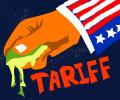
'If the near-term economic pain is absorbed more by those who have the ability and the financial strength to do so, then small and medium enterprises in downstream industries will emerge stronger from the trade imbroglio.'

Global trends and trading activity of foreign investors would largely dictate terms in the equity markets this week amid a lack of major domestic triggers, analysts said. Markets may face near-term consolidation due to elevated valuations, they noted. "While the previous week was predominantly shaped by developments in the US Federal Reserve policy, attention will now shift to the Bank of Japan's policy decision on December 19," Santosh Meena, Head of Research, Swastika Investmart Ltd, said.

Macroeconomic data announcements, global trends and trading activity of foreign investors would guide momentum in the equity market this week, analysts said. Markets ended a five-week losing streak and gained nearly a per cent last week, helped by a sharp rebound on Friday. Last week, the BSE benchmark jumped 500.65 points or 0.77 per cent and the Nifty gained 169.5 points or 0.87 per cent.

'The universe of PSU stocks is huge and diverse.' 'Investors should bet on specific sectors and stocks from the basket as most of them may continue to consolidate after years of outperformance.'
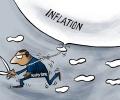
'Deposit and lending rates have started to fall considerably. It is likely to spur investment and consumption of durables.'

In trade negotiations, as in chess, sometimes you need to accept a temporary disadvantage to secure a better long-term position, points out Sonal Varma, chief economist (India and Asia ex-Japan) at Nomura.

The escalation of conflict in the West Asian region is expected to push already high logistics costs besides hurting trade in sectors such as oil, electronics and agriculture, according to exporters. They said that insurance costs for exports to the countries directly involved in the war could also go up, which will impact Indian exporters' working capital. Think tank Global Trade Research Initiative (GTRI) stated that the conflict is already hurting India's trade with countries like Israel, Jordan, and Lebanon.

'The market's nervousness ahead of anticipated US tariffs has led to a significant downturn in Indian equities.'

The era where nations thrived through rigid alignments is giving way to an age where the connective State defines power. For India, that era has arrived, points out Dr Nishakant Ojha.
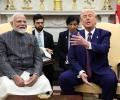
'Trump administration wanted a positive tone at this summit, but there was still some anxiety that there could be some awkward moments -- and there were not.'

'As the global economy undergoes significant transformations in 2025, India's ability to navigate the complexities of trade wars, financial realignments, and emerging blocs will be pivotal,' explain Harsh V Pant and Soumya Bhowmik.

Retail inflation eased to a nearly six-year low of 3.16 per cent in April mainly due to subdued prices of vegetables, fruits, pulses, and other protein-rich items, creating enough room for the Reserve Bank to go for another round of rate cut in the June monetary policy review. The Consumer Price Index (CPI) based inflation was 3.34 per cent in March and 4.83 per cent in April 2024. It was 3.15 per cent in July 2019.

'Geopolitical risks and their impact on oil prices, if any, are another concern for global markets, particularly for India.'

Reliance Industries Ltd on Monday reported a 5 per cent fall in the net profit for the July-September quarter, as weak oil refining and petrochemical business hurt operational performance.

The rupee tumbled 3 per cent against the US dollar in 2024 as concerns over slower economic growth and a stronger greenback in global markets weighed, but it was among the least volatile currencies in the world and the headwinds may be less intense in the coming year.
.jpg)
The rated oil and gas companies, Fitch said, have a significant proportion of foreign currency-denominated debt.

If a 5% to 10% fall in the equity market gives you sleepless nights, you are not cut out for a 75% to 80% allocation to equities and must reduce it.

Pushing a barrel of oil back to around $100 would require a reduction of production of about two million barrels a day - a cut that would fall predominantly on Saudi Arabia.

tailwinds of a remarkable year and handsome investor returns, Indian equities are set for an eventful journey in 2024, with a slew of local and global cues -- varying from interest rates to Lok Sabha polls to geopolitical happenings. Analysts are of the view that the bull run in the domestic equity market will continue, and over the next 3-6 months, the benchmark indices -- Sensex and Nifty -- could climb up to 7 per cent. In 2023, the 30-share BSE Sensex jumped 11,399.52 points or 18.73 per cent, and the NSE Nifty climbed 3,626.1 points or 20 per cent.

India is likely to be the fastest-growing Asian economy in 2022-23, according to analysts at Morgan Stanley. They expect India's gross domestic product growth to average 7 per cent during this period - the strongest among the largest economies - and contributing 28 per cent and 22 per cent to Asian and global growth, respectively. The Indian economy, they said, is set for its best run in over a decade as pent-up demand is unleashed.

The real benefits can be seen when prices stabilise, preferably at levels acceptable to both consumers and producers.
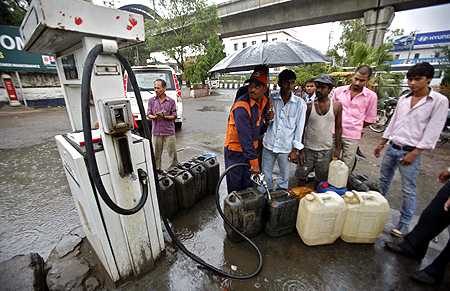
Global supply is staying in excess of demand.

Saudi Arabia's deep pockets and a strong financial system could help the country to ride out a low-price environment in order to protect its market share.

The WTO toolkit provides various instruments to deal with such situations - anti-dumping duties, countervailing duties and safeguard measures.

The rise in US bond yields spooked investors last week and there could a further increase given the inflation dynamics, according to Christopher Wood, global head of equity strategy at Jefferies. "The US bond market sell-off has continued over the past week, and with it the increased potential for an inflation scare. "Still, there is plenty of scope for bonds to sell off more since the last time the 5-year forward inflation expectation rate was running at current levels (namely in early December 2018), the 10- and 30-year bond yields were significantly higher at 2.91 per cent and 3.17 per cent, respectively," the market guru said in his newsletter GREED & fear. The 10-year and 30-year US Treasury finished at 1.34 per cent and 2.13 per cent, respectively, last week.

Riding on a bull run, equity investors became richer by Rs 128.77 lakh crore in the 2023-24 fiscal, driven by robust fundamentals of the Indian economy, increased investment inflows and promising corporate earnings. After a muted performance in 2022-23, equity markets made a remarkable recovery in FY24, giving handsome returns to investors. The 30-share BSE Sensex climbed 14,659.83 points or 24.85 per cent in 2023-24.

With this increase, diesel prices have touched a record high while petrol is at a 56-month peak.

The BJP-led government had raised excise duty nine times between November 2014 and January 2016 to shore up finances as global oil prices fell, but then cut the tax just once in October last year by Rs 2 a litre.

'If rate cuts happen, bond yields will come down and investors will make mark-to-market capital gains on them.'

Each bottle of pickle that leaves FarmDidi, headed to a consumer, has a little kahani behind it -- it's linked to the tale of a life, the life of a simple, striving village woman who created it, and that's what gives Manjari Sharma satisfaction and happiness.
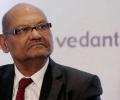
Mining magnate Anil Agarwal's conglomerate on Friday announced a major business shake-up, with flagship Vedanta Ltd approving a spin-off of its metals, power, aluminium and oil and gas businesses into separate listed entities and an overhaul of lucrative zinc unit planned as part of value creation and reducing debt load. Vedanta will issue one share of the five demerged businesses for every share held in the company, the firm said in a statement. The entire exercise, which would require shareholder and lender approval as well as a nod from the stock exchanges and courts, is expected to be completed in 12-15 months, its president for finance Ajay Agarwal said.

With the government reducing the net worth for new entities in fuel-marketing space to Rs 250 crore, the market is open for new players like Total, Adani, and Saudi Aramco -- and even supermarkets - to open fuel outlets.
